Peter
The Last BattlePeter, the High King of Narnia, is a returning ruler whose appearances bind the last crisis of the old world to the opening of a greater one. He first reaches Tirian as one of the seven Friends of Narnia in a vision that vanishes before Tirian can answer; later, after the destruction of Narnia, he stands crowned among its kings and queens. His authority is marked not only by rank, but by recognition: Tirian remembers his face from the vision and welcomes him as High King. At the close, Peter’s family’s death in a real railway accident gives the final change of worlds its decisive meaning: the Narnian adventures have ended, but the true story has begun.
Identity and Return
In Tirian’s vision, Peter is the king-like figure seated beside the old man. While the others start in alarm and a wine glass is swept from the table and broken, Peter turns pale but does not rise; instead, he clenches his hand and asks the apparition to speak, saying that he has a Narnian look and that the company are the seven Friends of Narnia. When Tirian remains unable to make a sound, Peter stands and invokes Aslan, identifying himself as Peter the High King. The vision then fades, and Tirian wakes still tied to a tree in the wet, pre-dawn wood. Peter’s brief appearance therefore gives Tirian a glimpse of help but no immediate rescue, intensifying the contrast between recognition and helplessness.
The vision is not Peter’s first connection to Narnia’s last emergency. After Tirian later sees him in the renewed country, Eustace explains how the Friends gathered: Digory and Polly brought the group together partly to talk about Narnia and partly because Digory felt they were somehow wanted there. Tirian’s ghostlike appearance, followed by his disappearance without a word, convinced them that something was happening. Their problem was how to reach Narnia, since wishing alone could not take them there. The old Magic Rings that Digory and Polly had used as children had been buried in the garden of a London house that had since been sold.
The Rings and the Railway
Peter and Edmund went to London early in the morning to recover the Rings from the garden. Disguised as workmen, they entered from the back so that anyone who saw them might think they had come to deal with the drains. Peter succeeded and sent the others a wire the following day. Because Peter and the older Friends could not return to Narnia in the same way as the younger ones, the plan was for Eustace and Jill to receive the Rings on their way back to school. The Rings, however, were not used: as Eustace recounts, he and Jill were travelling by train with Digory, Polly, and Lucy when a violent jolt and noise brought them into Narnia, where they found Tirian bound to a tree.
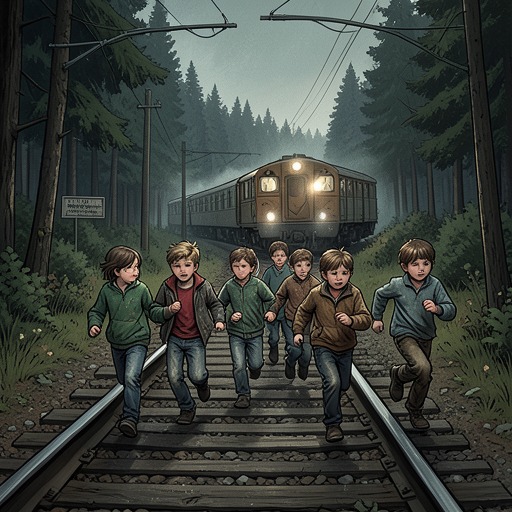
Peter’s account of his own arrival comes later, after the Friends are together again. He and Edmund were standing on the railway platform as the train approached, and Peter remembers thinking it was taking the bend far too fast. He also recalls the odd possibility that his parents, Edmund’s parents, and Lucy’s parents were on the same train, though Lucy did not know it. The narrative initially makes the reunion at the platform part of the practical plan to hand over the Rings; Peter’s recollection reveals that the railway disaster overtook that plan and gathered the family into the same catastrophe.
High King in the Renewed Country
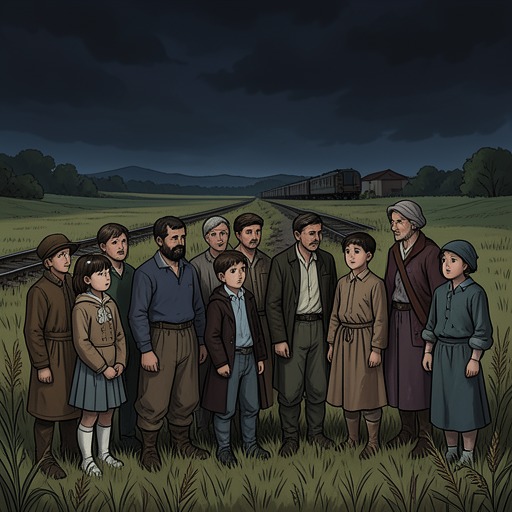
When the hideous creature carrying the Tarkaan vanishes after Peter’s command in Aslan’s name, Tirian turns and sees seven crowned kings and queens in glittering clothes. The kings wear fine mail and hold drawn swords. Jill steps forward and introduces Tirian to Peter as the High King over all the kings in Narnia. Tirian recognizes Peter’s face from his earlier vision, though it now appears nobler, and kneels to kiss his hand. His greeting is formal and direct: Peter is welcome to him. The encounter answers the earlier, incomplete recognition at the table: Peter had seen Tirian and called on him to speak, but only here can Tirian respond and acknowledge the king before him.
The contrast between Tirian’s battlefield condition and his appearance among the crowned company makes the transition visible. He feels awkward, imagining that he has come in blood, dust, and sweat; then realizes that he is clean, cool, and dressed as he would have been for a great feast at Cair Paravel. His welcome is thus part of a changed order in which the old king’s authority and the returning High King’s are not presented as rivals. Tirian approaches Peter with courtesy and loyalty, while Peter stands among the rulers who have come into this country beyond the old Narnia.
The End of the Old Order
At the Door, Aslan raises his head and roars first, “Now it is time!” and then “Time!” before the final, immense cry, “TIME.” The Door flies open. Peter is present as the old order reaches its cosmic ending: the stars are called home, and the spreading darkness in the sky is revealed to be emptiness where the stars have been. The stars arrive as people, shining behind the company and casting light over the Narnian woods. Peter’s role in these scenes is that of a witness and one of the gathered rulers, not the agent of the destruction; Aslan gives the summons, and the world’s ending proceeds under his command.
The creatures who come toward Aslan are divided by their response to him. Those who look at him with fear and hatred swerve to his left and disappear into his shadow; Talking Beasts among them cease to be talking animals. Others look at him with love, even when frightened, and enter by his right. Among the arrivals are creatures the company had thought dead, including Roonwit, Jewel, Farsight, and Poggin. Peter’s presence at this passage places his reunion with Narnia within a judgment and separation wider than political victory: entry into the new country depends on the encounter with Aslan, not merely on having belonged to the old world.
When the dying sun and moon have merged into a fiery mass, Aslan says, “Now make an end.” The giant takes the sun and squeezes it until darkness falls. These events carry Peter from the recovery of the Rings and the interrupted railway journey to the end of Narnia itself. The return is not a restoration of the former kingdom in its old form; the old world is brought to its conclusion while Peter and the others stand at the threshold of what follows.
Death and the Great Story
At the end, Aslan tells the children that the railway accident was real and that their father, mother, and all of them are dead, using the terms they had once used for the Shadow-Lands: “The term is over: the holidays have begun. The dream is ended: this is the morning.” Peter’s memory of the train travelling too fast around the bend now belongs to the same event that carried the Friends toward Narnia. The accident is no longer merely the unexplained interruption of a journey; it is the point at which their mortal lives and Narnian adventures come to their close together.
Peter’s final significance lies in this changed perspective on endings. Aslan no longer looks like a lion as he speaks, and the account turns from the end of the children’s lives to the beginning of the Great Story, whose chapters continue and improve upon one another. Peter is among those who pass from the Shadow-Lands into that beginning. His return as High King does not simply restore his earlier Narnian sovereignty: it places the remembered kingdom within a story that exceeds it, where death marks passage rather than final erasure.